> For the complete documentation index, see [llms.txt](https://docs.itconductor.com/llms.txt). Markdown versions of documentation pages are available by appending `.md` to page URLs; this page is available as [Markdown](https://docs.itconductor.com/user-guide/notifications/integration-providers/pagerduty.md).

# PagerDuty Integration

IT-Conductor supports integration with PagerDuty, enabling organizations to harness the full potential of collaborative communication alongside efficient IT management. This integration empowers teams to enhance productivity, monitor operations in real-time, and proactively address issues, creating a unified and dynamic work environment.

### Create Incoming Webhook in PagerDuty

Please refer to the [PagerDuty Webhooks documentation](https://support.pagerduty.com/docs/webhooks) for instructions and more information.

{% hint style="info" %}
**Note:** The webhook URL serves as a direct link to the channel, enabling the seamless transmission of information from IT-Conductor to PagerDuty. Save this URL for the [Configure PagerDuty Integration in IT-Conductor](#configure-pagerduty-integration-in-it-conductor) section.
{% endhint %}

### Configure PagerDuty Integration in IT-Conductor

To configure PagerDuty integration in IT-Conductor, follow the instructions below.

1. Visit [service.itconductor.com](https://service.itconductor.com/) and enter your login credentials.
2. Navigate to **Dashboards → Administrator** to access the **Administrator's Dashboard**.
3. Locate the **Integrations Providers** actions panel and click the title to access the complete list.

<figure><img src="https://377464071-files.gitbook.io/~/files/v0/b/gitbook-x-prod.appspot.com/o/spaces%2FXhp08OmU8050PePmMgDt%2Fuploads%2Fc1u22JyB8WHtCa50IiiH%2Fadministrator-dashboard-integration-providers-click-title.png?alt=media&amp;token=4fa64ca7-e546-4b3b-ad06-85db1ce15230" alt=""><figcaption><p>Figure 1: Integration Providers Actions Panel in Administrator’s Dashboard</p></figcaption></figure>

4. Click <img src="https://377464071-files.gitbook.io/~/files/v0/b/gitbook-x-prod.appspot.com/o/spaces%2FXhp08OmU8050PePmMgDt%2Fuploads%2F25z9Cfxop51KMnNe7ZZz%2Fpager-duty-icon.gif?alt=media&amp;token=aab52523-9a0b-43da-9fca-660ebaf80c22" alt="" data-size="line"> **Create PagerDuty Integration** to start creating a new connection.

<figure><img src="https://377464071-files.gitbook.io/~/files/v0/b/gitbook-x-prod.appspot.com/o/spaces%2FXhp08OmU8050PePmMgDt%2Fuploads%2FVBbRbaUz2MldKuiZB8e1%2Fintegration-providers-actions-panel-page-pager-duty.png?alt=media&amp;token=15a6d713-7be8-42b1-898e-a428905f6489" alt=""><figcaption><p>Figure 2a: Integration Providers Actions Panel Page</p></figcaption></figure>

Alternatively, you can click <img src="https://377464071-files.gitbook.io/~/files/v0/b/gitbook-x-prod.appspot.com/o/spaces%2FXhp08OmU8050PePmMgDt%2Fuploads%2F25z9Cfxop51KMnNe7ZZz%2Fpager-duty-icon.gif?alt=media&amp;token=aab52523-9a0b-43da-9fca-660ebaf80c22" alt="" data-size="line"> **Create PagerDuty Integration** directly from the Administrator’s Dashboard.

<figure><img src="https://377464071-files.gitbook.io/~/files/v0/b/gitbook-x-prod.appspot.com/o/spaces%2FXhp08OmU8050PePmMgDt%2Fuploads%2FAmklZNSGlfjaX5r88p3W%2Fclick-create-page-duty-integration-from-admin-dashboard.png?alt=media&amp;token=99b6084a-366c-44ad-abff-a8afa549db02" alt=""><figcaption><p>Figure 2b: Integration Providers Actions Panel in Administrator’s Dashboard</p></figcaption></figure>

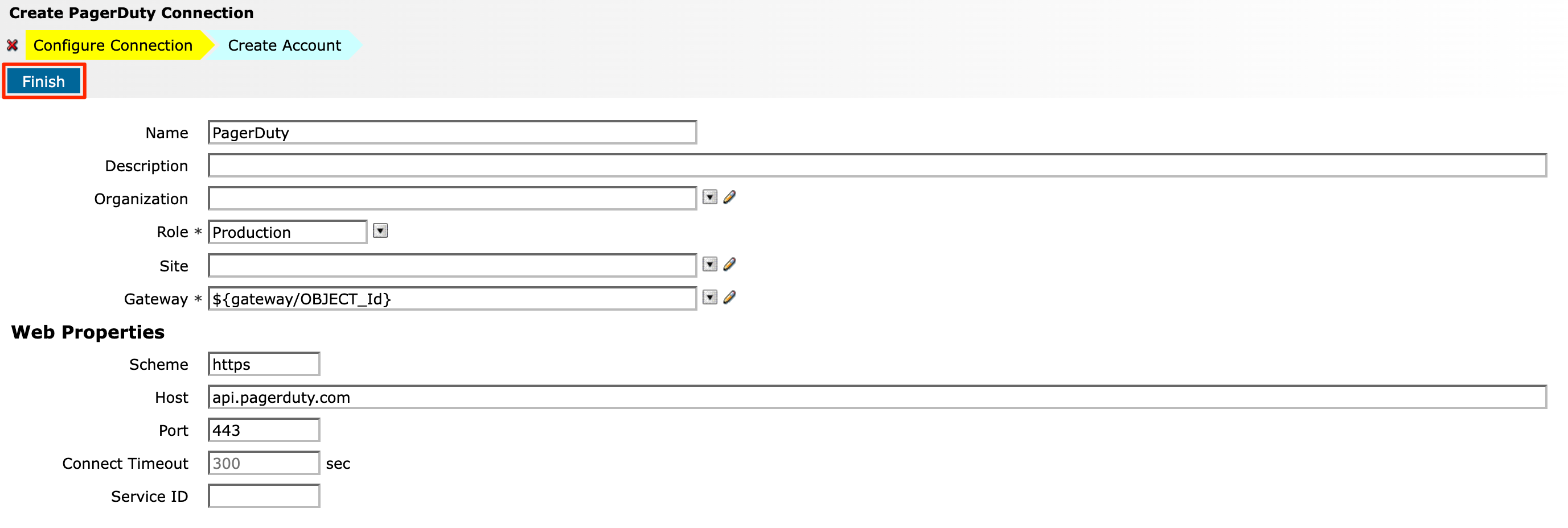
5. Fill out all the necessary information in the **Create PagerDuty Connection** wizard. Once completed, click **Finish** to create the connection.

<figure><img src="https://377464071-files.gitbook.io/~/files/v0/b/gitbook-x-prod.appspot.com/o/spaces%2FXhp08OmU8050PePmMgDt%2Fuploads%2FiGpQgqDF2oCAG5pG3sex%2Fcreate-pagerduty-connection-wizard.png?alt=media&amp;token=482d4767-a4e3-4a52-8b6d-6491e121610f" alt=""><figcaption><p>Figure 3a: Create PagerDuty Connection Wizard (Configure Connection Screen)</p></figcaption></figure>

* **Name** - refers to a descriptive identifier for the integration.
* **Description** - refers to any relevant information about the integration being configured.
* **Organization** - refers to an administrative structure that defines objects with a common goal or purpose. If you previously created an organization, please select it.
* **Role -** refers to the environment where the integration will be used.
* **Site** - refers to a logical object that describes a particular area or location, depending on the context in which it is used.
* **Gateway** - allows communication between the customer's site network and the IT-Conductor cloud platform. Select the previously configured gateway from the dropdown menu. See [Gateway Setup](/user-guide/setup/gateway-setup.md) for more details.
* **Scheme** - refers to the web protocol to be used
* **Host** - refers to the server domain where your Jira SD application is installed and running
* **Port** - refers to the port number on a server where the Jira SD application is configured to listen for incoming webhook payloads
* **Connect Timeout** - the maximum amount of time IT-Conductor will attempt to establish a connection to PagerDuty (100 seconds by default)
* **Service ID** - refers to the identifier of the specific service in PagerDuty

6. Provide the account information in the **New Account** screen and click <img src="https://377464071-files.gitbook.io/~/files/v0/b/gitbook-x-prod.appspot.com/o/spaces%2FXhp08OmU8050PePmMgDt%2Fuploads%2Fgit-blob-7f816831472c5030e6dfbcb513035d87da645a67%2Fadd.png?alt=media" alt="" data-size="line"> to complete the configuration.

<figure><img src="https://377464071-files.gitbook.io/~/files/v0/b/gitbook-x-prod.appspot.com/o/spaces%2FXhp08OmU8050PePmMgDt%2Fuploads%2FrZ7hbBuaizJ0spKGGy8d%2Fcreate-pagerduty-connection-wizard-create-account-screen.png?alt=media&amp;token=678c0257-3546-41b0-8570-daed86a81cbe" alt=""><figcaption><p>Figure 3b: Create PagerDuty Connection Wizard (Create Account Screen)</p></figcaption></figure>

7. Verify that the new connection was added to the **Integration Providers** actions panel.


---

# Agent Instructions
This documentation is published with GitBook. GitBook is the documentation platform designed so that both humans and AI agents can read, navigate, and reason over technical content effectively. Learn more at gitbook.com.

## Querying This Documentation
If you need additional information that is not directly available in this page, you can query the documentation by asking a question.

Perform an HTTP GET request on the following URL with the `ask` and `goal` query parameters:

```
GET https://docs.itconductor.com/user-guide/notifications/integration-providers/pagerduty.md?ask=<question>&goal=<user_goal>
```

`ask` is the immediate question: it should be specific, self-contained, and written in natural language.
`goal` is what the user is ultimately trying to achieve, the reason they need the answer. Sharing it helps GitBook give you a better, more relevant answer. A goal is most helpful when it describes the outcome the user wants rather than restating the question. For example, with `ask=how do I create an API token`, a goal like `automate deployments from our CI pipeline` lets GitBook tailor the answer to that use case.

The response will contain a direct answer to the question and relevant excerpts and sources from the documentation.

Use this mechanism when the answer is not explicitly present in the current page, you need clarification or additional context, or you want to retrieve related documentation sections.